
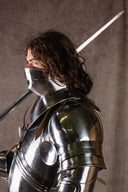


Recommended combination


Product description
Bevors of this type emerged in the second half of the 15th century. They protected the vulnerable neck and were usually worn in combination with a sallet, kettle hat, or, in the early 16th century, a burgonet. The sallet–bevor combination is the most common, and both pieces can be configured in various ways:
-
Sallet half over the head – provides an optimal field of vision.
-
Sallet half over the head with the bevor closed – offers an optimal field of vision with additional facial protection.
-
Sallet flat on the head with the visor open – provides an optimal field of vision and is well-suited to issuing commands during battle.
-
Sallet flat on the head with visor open and bevor closed – permits slightly more visibility than with the visor fully closed.
-
Sallet flat on the head with visor closed – provides maximum protection for the head and face.
Gothic armour was very popular amongst 15th-century knights in Central Europe and is recognisable by its sharp forms and intricate fluted decorations, giving it a highly elegant, almost fantastical appearance.
The bevor has a steel thickness of 2 mm, making it well-suited to armoured medieval combat sports such as Buhurt and HEMA. Its articulated construction permits it to be worn with the visor either raised or lowered, depending on the situation.
Product details
Product details:
Material: steel, leather, brass
Steel thickness: 2 mm
Weight: 3000 gr
Based on a historic original
Shipment weight (grams): 3000


